A narrative Advanced profile of José Mujica, tracing how guerrilla violence, political imprisonment, democratic compromise, and presidential power shaped his philosophy of time and enough.
Читай текст у контексті й натискай підсвічені слова, щоб відкрити переклад, транскрипцію та дії зі словником.
Vocabulary:25(✓0+0-25)
knownlearningnew
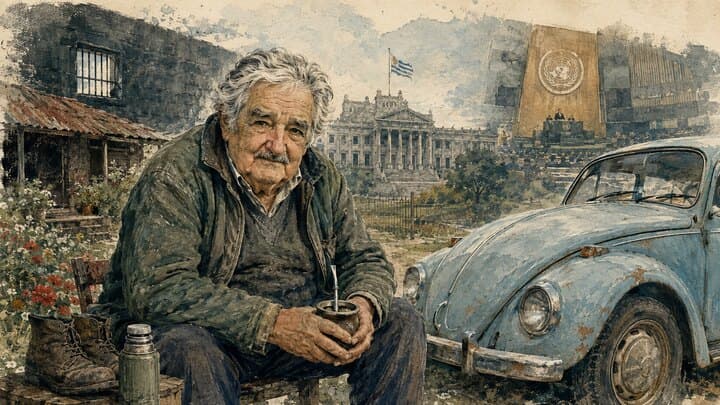
In September 2013, José Mujica walked to the green marble podium of the United Nations General Assembly and spoke less like a president defending a national programme than an old man questioning an entire civilization. Humanity, he argued, had confused development with endless consumption.
The speech matched the international image already forming around him. Uruguay's president lived on a flower farm and drove an aging Volkswagen Beetle. He treated personal as a defense of freedom rather than a performance of sacrifice.
The image was memorable because politics usually displays power through distance and possession. Yet Mujica's real question was more demanding: if turns human time into a machine for buying, what exactly counts as a rich life?
Before the Old Man at the Podium
José Alberto Mujica Cordano was born in Montevideo on 20 May 1935. His father died when he was young, and the family experienced financial insecurity. He worked with flowers, joined cycling clubs, and entered politics through a traditional party.
By the 1960s, Uruguay was facing economic decline, social conflict, and growing state repression. Mujica helped build the Tupamaros, an urban that believed ordinary electoral politics could no longer produce deep change.
The group used robbery, kidnapping, sabotage, and attacks as part of an . It also cultivated an image of redistributing stolen resources, but political theatre did not remove the fear, injury, and death produced by violence.
Any honest account of Mujica must hold two facts together. The state became increasingly brutal, and the Tupamaro was not a peaceful democratic campaign.
Mujica was arrested several times, escaped prison, and was shot during capture. By 1972 the security forces had largely defeated the movement, before Uruguay's military established a dictatorship the following year.
The Cell Reduces the World
The dictatorship selected nine Tupamaro leaders as prisoners whose lives could be threatened if resistance resumed. Mujica was treated as a of the state rather than an ordinary prisoner.
Across fourteen years in custody, he was moved among military facilities and endured long periods of . At times he had little light, little water, almost no reading material, and scarcely any human conversation.
He later described struggling to protect his mind by observing tiny details and speaking to creatures in the cell. The ability did not come from pretending pain was useful; it came from finding a mental world the jailers could not completely control.
Prison is often turned into the chapter that magically produces wisdom. Mujica's later philosophy was shaped there, but survival also left damage. His simplicity cannot be separated from years when nearly every object and ordinary choice had been removed.
Weapons Give Way to Votes
Civilian government returned in 1985, and an released political prisoners while covering offenses committed during the years of conflict. Mujica emerged into a country trying to rebuild institutions without resolving every demand for justice.
The required former enemies to accept rules they had once rejected or destroyed. Mujica and other former Tupamaros entered the Broad Front, a left-wing containing socialists, communists, centrists, unions, and independent groups.
His transformation was not a conversion from conviction to emptiness. It was a movement toward : lasting change would depend on persuasion, institutions, elections, and the slow construction of majorities.
He became a deputy, senator, and agriculture minister. In each role, the former underground fighter learned that a could preserve democratic cooperation even when it failed to satisfy a revolutionary imagination.
Winning also changed the scale of responsibility. A movement can define itself by what it opposes; a government must keep schools, hospitals, farms, wages, budgets, and public services functioning at the same time.
A Farmhouse Acquires State Power
Mujica won the 2009 election and served as president from 2010 to 2015. He continued living with his wife, Lucía Topolansky, on their modest farm outside Montevideo and chose most of his presidential salary.
He did not move into a , and the old Beetle became more famous than many official policies. These choices narrowed the visible distance between office and citizen, giving his words unusual credibility.
But personal modesty is not a complete programme for government. Uruguay's institutions, civic organizations, legislature, and earlier Broad Front administrations all shaped what became possible during his term.
Several internationally noticed laws made the period a symbol of . Uruguay expanded abortion rights and legalized through democratic legislation.
The government also created an unprecedented system of , placing production and sale under state rules. The policy treated illegal markets and public health as practical problems rather than stages for moral panic.
Mujica's manner generated enormous abroad. At home, however, citizens judged education, infrastructure, security, public spending, and implementation, not only the president's memorable speeches.
That difference matters. An international audience could celebrate a philosopher-president, while Uruguayans lived with the ordinary successes, delays, conflicts, and frustrations of an actual administration.
The Cost Hidden Inside a Purchase
Mujica did not argue that poverty was virtuous. His target was a system that required endless growth while leaving intact and teaching people to mistake new desires for personal freedom.
He distinguished chosen simplicity from deprivation. A person without food, shelter, health care, or education does not gain freedom from having less; the critique begins after basic dignity is secure.
Against the prestige of , Mujica proposed another calculation. People buy objects with money, but they obtain that money by giving hours of their lives to work.
To a purchase honestly, then, is to ask how much irrecoverable time it costs. The point is not that all comfort corrupts, but that an expanding appetite can quietly take command of a person's schedule.
Time is , and that limit gives value to friendship, love, rest, solidarity, conversation, and attention. In this philosophy, simplicity protects the hours in which life is actually experienced.
A Useful Example Must Remain Human
Mujica's popularity sometimes flattened him into a secular saint: the poor president with the wise quotation and humble car. That story hides the armed choices of his youth, the collective nature of reform, and the contested record of governing.
His importance lies less in moral perfection than in political change. A man who had once tried to force history with weapons later spent decades asking citizens for votes and accepting that opponents would remain part of the country.
After leaving the presidency, he returned to the Senate before retiring in 2020. Even as cancer narrowed his final years, he continued speaking about democracy, younger generations, mortality, and the need to use life rather than merely preserve it.
Mujica died on 13 May 2025, one week before his ninetieth birthday. His is not a recipe for owning an old car; it is an argument that freedom depends on what controls our limited time.
That argument becomes stronger when kept beside his contradictions. The life behind it moved through violence, punishment, elections, compromise, authority, illness, and relinquishment. Enough was not the absence of ambition. It was the attempt to decide what ambition should serve.






Обговорення
щоб коментувати, лайкати відповіді та скаржитися на коментарі.